East path on High Level Bridge too narrow before suicide barriers added, audit finds
The suicide-prevention barriers on the High Level Bridge have put such a squeeze on space for cyclists and pedestrians, at least one of the paths will likely be restricted to one-way traffic only.
A safety audit prepared by third-party consultant Urban Systems found the east path wasn’t wide enough for a two-way bike and pedestrian path in the first place. The suicide-prevention barriers have only made the problem worse.
“That issue of losing width on the bridge, I didn’t catch it,” Coun. Scott McKeen said of the decision to install the barriers two years ago.
“I probably should have recognized we were losing some width on that trail and therefore creating issues of safety.”
Urban Systems said the barriers reduced the width of each path by 30 centimetres.
“On-site observations indicated that these widths resulted in some conflicts (near collisions) between users of the pathways on both sides of the bridge,” the report says.
The east path is particularly dangerous, as it’s only 2.3 metres wide, compared to 2.8 metres on the west path.
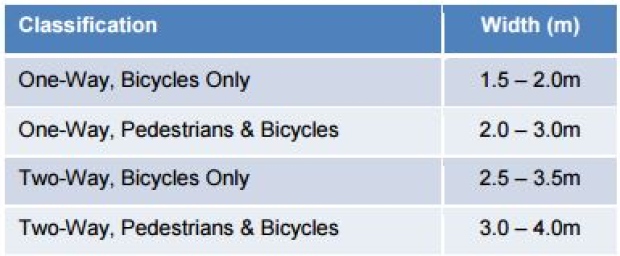
According to minimum wipath widths outlined by the Transportation Association of Canada, the paths on the High Level Bridge aren’t fit for two-way bike and pedestrian traffic. (Urban Systems)
That means at its widest, the east path doesn’t make the cut for two-way pedestrian and bike traffic, according to national guidelines set by the Transportation Association of Canada.
The west side doesn’t measure up either, but the road safety audit team said it’s close enough, given the historic and structural constraints of the bridge.
City spokesperson Holly Budd said the city tried to abide by TAC guidelines for new projects, but it’s not always possible with retrofits.
Two years ago, council was presented with several options for the barriers that ranged in price between $1.2 million and $7.4 million. They opted for the $3 million version, but McKeen said if he could go back in time he might choose differently.
“This is probably the most important active transportation connection we have in Edmonton,” McKeen said. “So it’s not an insignificant issue when we have problems with cyclists and pedestrians crossing that bridge.”
Still, he said he doesn’t think it’s a good idea to pull the barriers down now.
The report included 40 recommendations, starting with reducing the east trail to one-way pedestrian and bike traffic.
McKeen said council may decide to do that in the short term, but the city will have to keep an eye on the number of people using the paths. If it gets to be too much, he said the paths may need to be widened.
The report suggests several long-term solutions, including widening the paths, removing a lane of traffic, constructing a new pedestrian bridge, or moving cyclists to the top bridge deck.
McKeen said none of the solutions will be easy or cheap, given the historic nature of the bridge. He suggested the city could use photo radar revenue to pay for the changes.
“This is transportation safety, so I think it legitimately could be applied to this,” he said.
Other recommendations in the report include improving signs along the path, changing the intersections on the north and south ends of the bridge, and better separation between the path and vehicles,
Councillors will debate the options at an urban planning committee meeting on Wednesday.