Russian anthrax outbreak linked to climate change
A 12-year-old boy has died and 20 people have been infected in an anthrax outbreak in Russia’s northern Yamalo-Nenets region, the local authorities said.
Ninety people have been hospitalized on suspicion of having contracted the disease.
Scientists believe that climate change was the main reason behind the outbreak, as abnormally warm weather caused permafrost melting and exposed a reindeer corpse infected by anthrax decades ago.
The Russian emergencies ministry said it has evacuated 238 people, including 132 children, from reindeer herders’ camps close to the site of the outbreak.
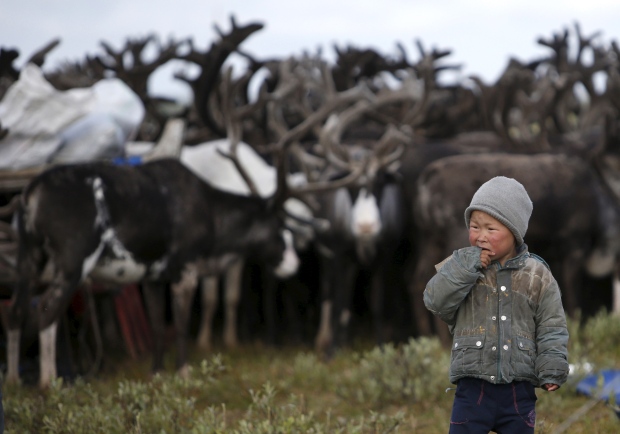
A boy, one of the children of local herders, stands near a herd of reindeer at a camping ground, some 200 km (124 miles) northeast of Naryan-Mar, the administrative centre of Nenets Autonomous Area, far northern Russia, in a 2015 photo. The Russian emergencies ministry said it has evacuated 238 people, including 132 children, from reindeer herders’ camps close to the site of the outbreak. (Sergei Karpukhin/Reuters)
The deadly disease also known in Russia as “Siberian plague” was last recorded on Yamal peninsula 75 years ago.
More than 2,300 reindeer have died in the current outbreak in the region 2,000 kilometers (1,200 miles) northeast of Moscow. Yamalo-Nenets governor Dmitry Kobylkin said all reindeer in the area have now been vaccinated and the deaths have stopped.
The government will earmark 90 million rubles ($1.8 million) to help the nomads, who are indigenous to the remote region, build new homes in a new settlement. Yamal’s nomads live in temporary dwellings called chums that are typical for the nomadic people of Siberia as well as parts of Mongolia and China.