The Witness
“The Witness,” screenwriter James Solomon’s documentary about the 1964 Kitty Genovese murder case, is an excellent reminder not to believe everything you read.
True crime aficionados recognize Genovese’s name and recall the details of the case: she was a barmaid in Kew Gardens, Queens who was randomly stabbed by a stranger named Winston Moseley—who later told police he was just looking for a woman to kill—then raped and robbed by him a while later after he returned to finish the job. The New York Times later reported that a total of 38 witnesses heard and even saw some part of the attack but didn’t call police and otherwise failed to intervene or even call attention to it. Like a lot of ghastly, simple true crime tales this one soon stopped being a simple account of a tragedy and became something much bigger: a story about the anonymity and callous indifference of big cities, where millions of people could live packed tight without knowing or caring what happens to each other.
Turns out that’s not how things happened. Not at all. There were indeed neighbors who were aware or half-aware that something horrible was happening to a woman in the neighborhood, or at the very least that some woman was screaming horribly, but the idea that 38 people just sat there and let it unfold without doing anything—while remaining riveted, as if it were a radio drama or a TV show—is simply false. A lot of people in and near the scene of Genovese’s murder had no idea what was going on, and there were in fact people who tried to help or contact police. When, then, did an untrue version of the story become enshrined as legend?
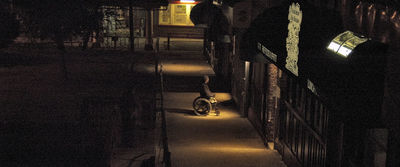
The short answer: The New York Times is to blame. This film’s main character is Bill Genovese, one of Kitty’s many younger siblings. He adored his big sister and was devastated not just by losing her so suddenly and violently but by the account of her death in the Times, which went on to spur many fictional retellings, including episodes of TV’s “Perry Mason,” “All in the Family” and “Law and Order.” Bill is in a wheelchair now after losing both his legs. We eventually learn that Bill’s leglessness, too, is connected to the murder—specifically to the Times’s coverage of the murder, which was not just incorrect but willfully exaggerated, to sell papers and set an agenda.
If I’m making “The Witness” sound like a film about journalistic ethics, at times more so than the story of the Genovese family’s grief and loss, well, it is that. In fact you could say that, for a good part of its running time, it is mainly about what happens when the institutions we entrust to tell our stories fail us. Bill is our surrogate, chasing down the real story for reasons of personal catharsis, and the information he gleans by studying newspaper and TV stories about the case and contacting the reporters eventually tells us a lot about the relationship between a free press and the society it chronicles. There are real consequences to incorrect or false stories, especially ones dealing in catastrophic loss. Any tangential benefit of telling a wrong or concocted story about real events—such as the invention of the 911 emergency system, which came about partly as a result of the public feeling collectively ashamed of itself because of the Genovese story—there are tangible downsides as well, and in the end they might, it not outweigh the benefits, at least balance them out.
One major bit of fallout from Genovese murder coverage was a false sense of cities as coldblooded places where people don’t know each other and don’t care what happens to each other. That might be true in particular situations but not in this one, and when people behave callously or indifferently to violence or suffering, it’s rare that every single person who’s aware of it doesn’t care enough to lift a finger. Bill ultimately learns that the people on his block did in fact act like members of a community, with some caveats: many of them didn’t know what was happening or didn’t appreciate the extent of the horror, they had no way of coordinating their efforts, and didn’t have all the available facts necessary to act as a group and do something to stop Kitty’s death.
“The Witness” might have benefited from a more thorough exploration of some of these issues, in particularly the New York Times’ arrogant indifference to the truth in this case. A retired reporter for the long-defunct New York Herald Tribune reporter tells Bill that he thought their Genovese story seemed fishy back in 1964, but that when he confronted the reporter about inconsistencies and mistakes (such as the number of witnesses and what, exactly, they saw) he was told, in essence, “Let it go, it’s a compelling story, what are you trying to do, ruin it?” The Times’
A.M. Rosenthal, who was the city editor for the paper during Genovese coverage and later became executive editor of the paper, an editorial page columnist, and finally a columnist for the New York Daily News, expresses more or less that point-of-view during an interview conducted before his death in 2006. Rosenthal wrote a whole book about the case, titled “38 Witnesses.” The Genovese story became a metaphor for urban apathy, but in conversation with Bill Genovese, Rosenthal seems to think that that was so important (in part because it led to the 911 emergency response system) that he won’t entertain the possibility that a wrong or inaccurate story should never have run in the paper, regardless of the rationale behind it. (Although the movie doesn’t get into this, the paper under Rosenthal supported the U.S. invasion of Iraq, which was at least partly motivated by information that was later proved to be exaggerated or false.)
Though the press angle is infuriating, the story of Bill, his siblings, his parents and his friends is devastating. The movie gets into how extraordinary events (such as murder) can complicate the already-fraught grieving process. Bill and his brothers tell the filmmaker that they were so young when Kitty died that they didn’t really know her as a person, and as they grew up, they were all so consumed with the idea of Genovese-as-symbol that they never really investigated the details of her life prior to the attack. Bill discusses some of those details in this movie, and the result might be the most satisfying and moving part of the entire story. You watch and listen as an emblematic character, basically an issue plus a name, is gradually filled in, to the point where she becomes fully human onscreen, perhaps for the first time since TV and film began retelling the story and what it means. This is a powerful film, but perhaps its greatest triumph is that for a brief time, it resurrects Kitty Genovese, and lets us see her as a person.