Maps to the Stars

David Cronenberg is near the top of directors whose works resist snap judgments. His mix of black comedy and unabashed melodrama is so delicate, and in some ways so off-putting, that at times it’s hard to tell if he’s kidding or serious (the answer is usually both). He’s been described as a horror filmmaker, and his longstanding fascination with bodily invasion and the fragility of flesh confirms that label, but a good many of his films play like horror movies even if they don’t have genetic mutations or other obvious “monsters,” because he’s nearly always more interested in the monstrous nature of obsession or desire, and the cruelty of the societies that enfold and define his characters. Look back over his filmography, and you realize that he hasn’t made an according-to-Hoyle horror picture since 1986’s “The Fly.” The horrific quality seems to come more from being appalled by what people can be, and do, and sympathetic to their urges.
“Map to the Stars,” based on Bruce Wagner’s novel, is another work in that vein, and although it’s been dismissed in some quarters as minor Cronenberg—and criticized for “getting Hollywood wrong,” or something—it’s a sneakily powerful movie. Not for nothing did Cronenberg model his remake of “The Fly” on tragic opera, then re-stage it as an actual opera with a libretto by David Henry Hwang. The film’s cast of anxious, insecure, duplicitous and sometimes murderous creative types inhabit a Los Angeles that seems as intimate, even inbred, as a stereotypical backwoods town; every other scene reveals that characters you didn’t know were connected are in fact part of an unofficial extended family, united not by blood by by deep hunger for validation. They want money and fame, too, of course, but those are just outward signifiers of what they’re really after: adoration. Love. Unconditional acceptance.
Julianne Moore stars as Havana Segrand, a formidable actress whose star has begun to fade now that she’s passed her fiftieth birthday. Like a lot of characters in this film—and a lot of characters in Cronenberg’s films and Wagner’s fiction, come to think of it—she’s defined by her tragic past, knows this all too well, and is palpably desperate to escape it and re-create herself. She wants to star in a biographical drama about her late mother Clarice Taggart (Sarah Gadon), a mercurial, psychologically and sexually abusive actress who might be a combination of Frances Farmer and Joan Crawford.
This one subplot, about a woman trying to master the awful memories of her mother by figuratively becoming her, gives you some clue what Cronenberg and Wagner are up to, not just with Havana but with all the major characters. Like Cronenberg’s little-seen but fascinating “Spider,” “Map to the Stars” often feels like a ghost story made by people who don’t believe in the supernatural. The mother appears to her daughter in a very plain way—as she might manifest herself in a theatrical production—but even though she’s clearly an outgrowth of Havana’s mangled psyche, you have to count her as an accusing spirit, rattling around in the haunted house of her daughter’s damaged mind and saying the most vile, undermining things. (As if the movie didn’t already glancingly echo “The Shining,” Cronenberg has Clarice appearing to Havana in a bathtub: shades of room 237.)
Havana, who will do or say just about anything to play her mother and hopefully win an Oscar, is the most vivid of the film’s troubled souls, thanks mainly to Moore’s utter disinterest in seeming powerful or dignified or otherwise stereotypically movie star-like. From “Short Cuts” and “Safe” onward, this actress has played troubled, desperate or generally put-upon characters so often that the Oscar she won for “Still Alice” might as well have been mounted on a medieval torture rack. But Havana proves merely the brightest star in this film’s constellation of scheming sufferers, a bunch whose individual manias are a bit too contrived and schematic, but fascinate anyway, thanks to the actors’ virtuosity and Cronenberg’s expert control of tone.
Havana’s regular therapist/masseuse/TV psychologist is a self-help guru named Dr. Stafford Weiss (John Cusack), a man who presents himself as selfless and caring, but seems unnervingly determined to crack open repressed minds mainly so he can root around and provoke extreme reactions. (When he manipulates Havana’s body on a yoga mat, Cronenberg’s staging always suggests sex, and sometimes rape.)
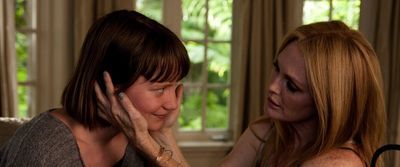
Havana’s new personal assistant, Stafford’s daughter Agatha Weiss (Mia Wasikowska), wears long gloves to cover arms that were burned in a mysterious fire; at first she seems almost Pollyanna-sweet, but soon enough she reveals a capacity for ruthlessness that rivals Havana’s. The ghost story parallels continue via Agatha, who haunts Stafford; his brittle, fearful wife Cristina (Olivia Williams, in the latest in a series of knockout supporting performances), and Agatha’s kid brother Benjie. The youngest Weiss is a cruel and territorial former child star who’s looking to escape the gilded prison of teen idol-hood and play edgy adult roles; he’s played by Evan Bird of “The Killing,” whose haircut and clipped delivery rather alarmingly evoke Frankie Muniz on “Malcolm in the Middle.” Compared to these misfits, slimeballs and emotional basket cases, Robert Pattinson’s limo driver and aspiring screenwriter Jerome Fontana seems well-adjusted, but as is so often the case with Wagner’s characters, you’d best not get too comfortable with him. (This is the second time Pattinson has spent time in a limo for Cronenberg, after “Cosmopolis,” and the second time he’s delivered a top-notch, blase-sexy-decadent performance.)
I’m not convinced that the film’s themes and situations are deep enough or well-articulated enough to deserve the filmmaking and acting placed in their service; as the story wears on and we glean new bits of information establishing the characters’ connections to one another, the story starts to seem less operatically inevitable than merely contrived and convenient: too neat, and trying to camouflage its too-neatness with wrenching scenes of violence and self-abasement. Towards the end, Cronenberg has pinned all of his people against the screen like so many laboratory specimens, ripped off their scabs, and vivisected their longings: an old wound here, a long–deferred dream there. But the movie sticks with you. It’s a fleeting nightmare that refuses to fade.
Source:: http://www.rogerebert.com/reviews/maps-to-the-stars-2015


